
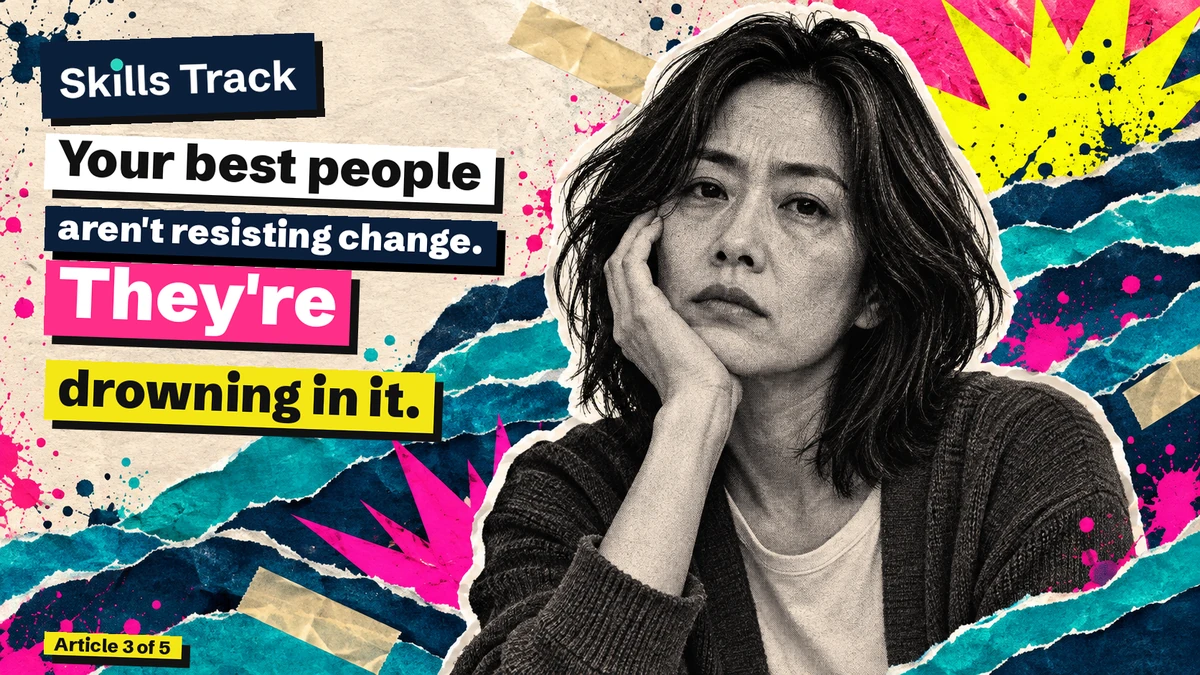
Somewhere in your organisation, a capable, committed person is quietly deciding they have had enough.
Not of the work. Of the constant restructures, system replacements, process rewrites and "exciting new ways of working" that all land on the same desk in the same quarter.
We call it change fatigue and treat it as a morale problem. The research suggests it is a performance problem with an identifiable cause, and leaders are creating it.
What the research says
A two-study paper in the Journal of Organizational Change Management found that employees in organisations experiencing more change reported greater change fatigue. That fatigue predicted greater strain, burnout and intention to leave, and lower engagement. It also showed indirect effects on teamwork, turnover intention and performance, through lower job satisfaction and commitment. The authors note both studies were cross-sectional, so these are associations, not proof of cause. The pattern is still clear: more change, more fatigue, worse outcomes.
The scale is not small. Deloitte's 2026 Global Human Capital Trends study, a survey of more than 9,000 business and HR leaders in 93 countries, reports that a third of employees say they went through more than 15 major changes in the past year alone. Only 27% of the leaders surveyed say their organisations manage change effectively. This is an industry survey, so treat the figures as indicative, but they match what I hear from the people living it.
The part leaders miss
Most change programs add to the load before they add to the capability. People are asked to keep running the business, learn the new system, attend the training, adapt their process and absorb the next announcement.
But research on what makes people open to change offers a way out. In a longitudinal study in the Journal of Applied Psychology, Wanberg and Banas found that three things predicted greater openness to workplace changes: the information people received, their self-efficacy for coping with the changes, and their participation in the change decision process. Lower acceptance of change was associated with lower job satisfaction, more work irritation and stronger intentions to quit.
Read that again. Information, confidence in your ability to cope, and a voice in the process. Those are not communications tactics. They are design requirements.
What that implies
Confidence to cope comes from being able to do the work. That is a capability problem, and it is solvable.
Participation means the people who do the work help design the training, rather than receiving a generic version of it.
Less burden comes from learning that happens in the flow of work, rather than from another module added to a full calendar.
An organisation that deals with change by adding more programs, more comms and more courses is spending its people's energy faster than it replenishes it.
The unapologetic version
If your people are tired, your change model is the cause. Fix the model.
I am working with a handful of organisations to design capability around one urgent problem at a time, with their experts in the room and minimal load on their teams. If you want to explore it, or put forward a problem for the pilot, start here.
Get startedReferences
[P-R] Peer-reviewed research. Reports provide scale and context, not proof of cause.
- [P-R] Cox, C. B., Gallegos, E., Pool, G. J., Gilley, K. M. & Haight, N. (2022). Mapping the nomological network of change fatigue: identifying predictors, mediators and consequences. Journal of Organizational Change Management, 35(4/5), 718–733.
- [P-R] Wanberg, C. R. & Banas, J. T. (2000). Predictors and outcomes of openness to changes in a reorganizing workplace. Journal of Applied Psychology, 85(1), 132–142.
- [Report] Deloitte (2026). Global Human Capital Trends 2026 (press release summary).